What Happens in the Marshaling Yard (And Why Your Truck Is Still Sitting There)

The phone rings at 9 a.m. on move-in day.
"Where's the freight?"
The driver swears he has been in line since 5 a.m. The labor crew is standing in an empty booth space. And somewhere a few miles away, a truck is sitting in a dirt lot with its engine off.
Welcome to the marshaling yard.
What Is a Marshaling Yard?
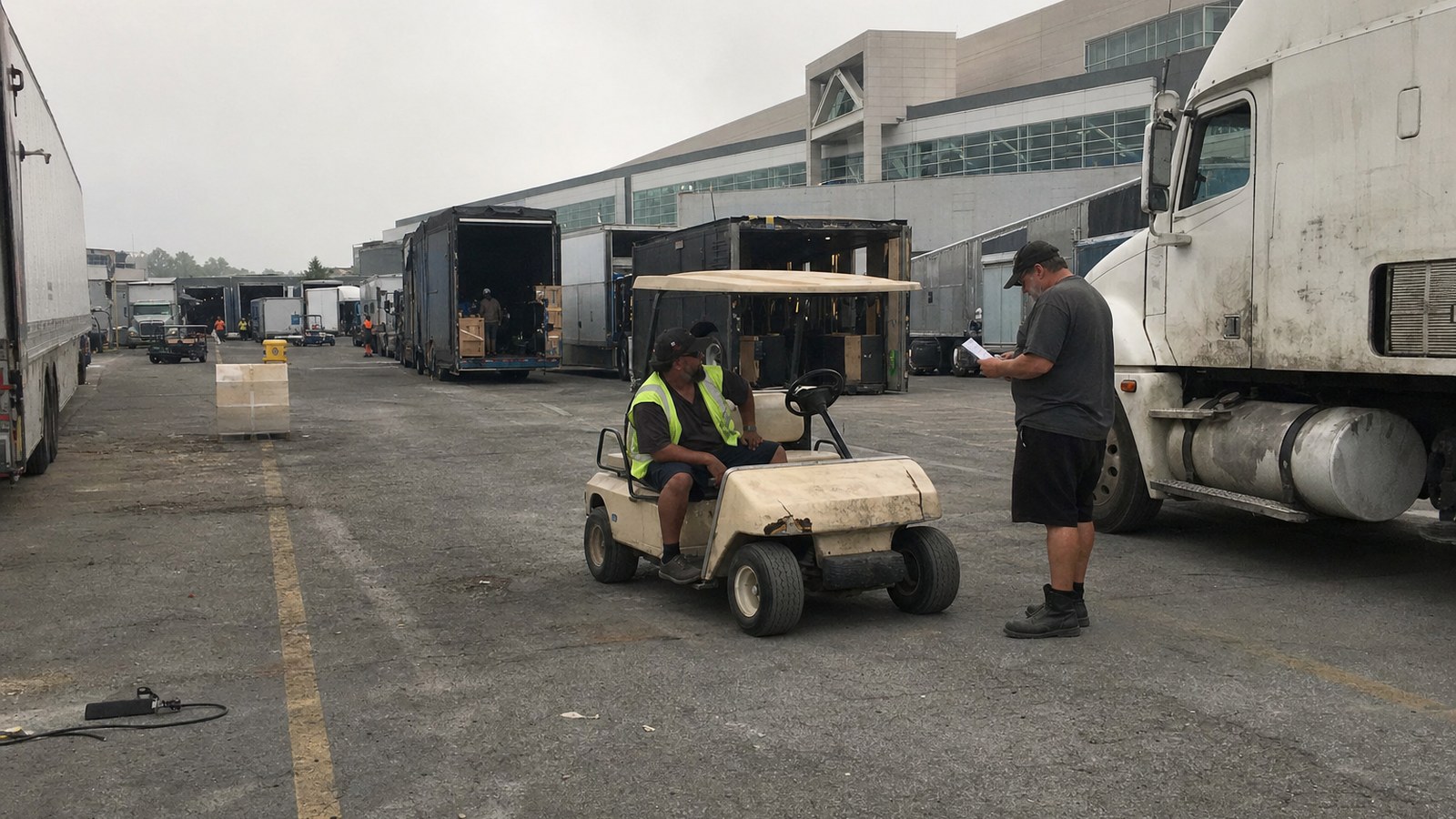
A marshaling yard is a big staging lot where trucks wait before they are allowed to unload at the venue. Big shows can't let thousands of trucks pull up to the loading docks at once. So the general contractor controls the flow from a lot that is often three or four miles away.
On a big show like CES, that can mean thousands of exhibitors and even more shipments. Some trucks carry freight for several booths.
Some booths ship on several trucks. You can see how it gets crowded.
Our own Martin Laurel has spent years working these yards. On Episode 027 of The Experience Builders Podcast, he compared it to a busy restaurant on a Friday night.
You get a buzzer. You wait outside. Then you wait again in the lounge.
At least restaurants don't weigh you.
The 6 Phases of the Marshaling Yard
Every truck moves through the same six steps. Here is the quick version.
- Line up. The truck arrives and waits to get into the yard. This wait can be short or very long.
- Weigh in. The truck gets weighed with the freight on board. This part is quick.
- Get a dispatch number. The driver parks and waits to be called. This is usually the longest wait.
- Head to the venue. The truck drives over and lines up for an open dock, often for 1 to 4 hours.
- Offload. Freight comes off the truck and goes to the booth space.
- Weigh out. The empty truck goes back to the yard for its empty weight.
Here is where the time really goes in each step.
Phase 1: The Free-for-All
Martin calls the first phase "the free-for-all." Drivers who know the drill show up early, sometimes a day ahead, and park at the front of the line. New drivers tend to roll in later and end up at the back.
But being first doesn't always mean going first.
Most big shows use targeted move-in. That means freight is scheduled by booth zone or booth number on set days and times.
A traffic person drives up and down the line in a golf cart, checking each driver's paperwork and target time. If your target is tomorrow, you may get sent back no matter how early you showed up.
Here is the catch most people miss. A driver sitting in that outside line is not officially "in line" yet. He's in line to get in line.
Phase 2: The Weigh-In
Once a truck makes it into the yard, a guy on a golf cart guides it to the scale. The truck gets weighed with everything on board. That's called the "heavy" weight.
What if one truck carries freight for three different booths? The driver's paperwork lists who owns what. A certified scale ticket helps, but the general contractor will usually weigh it anyway to double-check.
Why all the fuss over pounds? Your material handling bill is based on weight. The scale is where that number starts.
Phase 3: Where the Hours Disappear
After the weigh-in, the driver gets a dispatch number and parks. This is the bottleneck.
The venue might have 20 trucks unloading at once. The yard won't call the next group until that number drops. In Las Vegas, many venues don't have enough built-in dock ramps, so they use portable ramps and unload a few trucks at a time.
So how long can it take? If your truck is first, it could be unloaded in a couple of hours.
If it's last on a big show, it could be 10 to 12 hours. We have heard of drivers who are, as far as anyone can tell, still out there.
Phases 4 to 6: The Last Few Miles
When the dispatch number finally gets called, the driver gets a map and heads to the venue. The yard is often a few miles away, so that drive can take 20 to 30 minutes in show traffic.
Then comes another line. This one is shorter, usually somewhere between one and four hours, while the trucks ahead of it unload.
Phase 5 is the moment everyone has been waiting for. The freight comes off the truck and heads to your booth space.
Phase 6 is easy to forget. The empty truck drives back to the yard to get weighed again. The difference between the heavy weight and the empty weight is what you shipped, and that's the number on your material handling bill.
The Three Questions That Save a Day of Labor
When a driver says "I'm in line," that tells us almost nothing. These three questions tell us a lot.
- Do you have a dispatch number? If not, the truck isn't even inside the yard yet.
- What name did you check in under? More on this one below. It's a big one.
- How many loads are ahead of you? The freight desk can usually give a range.
Why does this matter so much? Because labor is waiting on that freight. If we know a truck is 20 loads out, we can move the crew to another job instead of paying them to stare at carpet.
That one phone call can be the difference between straight time and overtime. If you want to see how fast that adds up, read our post on the true cost of overtime.
The Wrong-Name Problem
This one causes more headaches than almost anything else in the yard.
Say you book a national carrier called Acme Freight. Acme hands the last leg to a local company, Joe Bob's Trucking. Joe Bob's driver checks in as Joe Bob's, not Acme.
Now the freight desk has no record of Acme. Your client is told the driver never checked in.
The driver swears he did. Everyone is right, and everyone is mad.
On move-out, it gets worse. If the general contractor can't find your carrier, your freight can get "forced" onto the show's default carrier. That usually costs more and moves on their schedule, not yours.
The fix is simple. Tell your labor and logistics team the name of every company that might touch the freight, plus the driver's cell number. We would much rather have too much information than go on a scavenger hunt.
Martin jokes that our team should get private investigator licenses. He is only half kidding.
Is There a Way to Skip All This?
Mostly, yes.
Shipping to the advance warehouse is the most common way around the yard. Your freight arrives days or weeks early.
It gets delivered to your booth space before install starts. No truck in a dirt lot, no 6 a.m. phone calls.
It does cost a bit more up front. But compare that to a full crew billing hours while a truck waits its turn. Which number would you rather explain to a client?
Direct-to-show shipping still makes sense for some projects. It just needs a plan. Here is what that plan should include:
- The exact target date and time for your booth zone
- A carrier that has worked trade shows before
- Every company name the freight might check in under
- The driver's direct cell number
- A labor schedule that can flex if the truck runs late
Why We Care So Much About a Parking Lot
It sounds funny to write a whole post about trucks waiting in a lot. But the marshaling yard is where a lot of install days are won or lost.
Half the drivers in that line, by Martin's estimate, have done this many times. The other half are seeing it for the first time and have no idea why they can't just back up to the dock.
Our job is to know the difference. Our transportation and logistics team works the yards in Las Vegas and Orlando all year. We know the freight desks, the targeted move-in rules, and which questions to ask before the first call comes in.
New to all of this? Our labor-side guide to your first trade show covers drayage, EACs, and the rest of the move-in vocabulary.
Let Us Watch the Line
You have enough to manage. Freight in a parking lot shouldn't be one more thing.
Tell us about your next Las Vegas or Orlando project, and we will help plan the shipping, the timing, and the labor around it. Call our Orlando office at 407-852-1910, our Las Vegas office at 702.800.5740, or schedule a discovery call.
Got questions for our team? Give us a call or fill out the form below and our team will be in touch as soon as possible.