Creative vs. Ops: Who Decides Whether Your Booth Is a Hit or a Headache?


Every experential agency has two brains. One dreams it. The other builds it. And when they don't talk to each other? That's when things get expensive.
Creative designs the dream. Operations figures out how to actually make it real.
Both sides are right. Both sides get frustrated. And both sides need each other way more than they'll ever admit at happy hour.
This is the story of the oldest fight inside every exhibit agency. And if you've ever watched a beautiful rendering crash into the reality of a loading dock at 5:47 AM, you already know how it ends.
The Rendering Looks Amazing. The Dock Door Doesn't Care.
Picture this. Creative walks into the review meeting with a gorgeous 3D rendering. Floating logo. Custom lighting rig. Clean lines. Moody shadows. The client loves it. Everyone high-fives.
Then someone from Ops raises a hand.
"How much does that logo weigh?"
The room goes quiet.
"Creative sees the show floor. Ops sees the loading dock, the freight bill, and the 6 AM call time. Both views matter. The trick is getting them in the same room before the rendering is final."
This is where the split happens. Creative is thinking about the attendee walking by. Ops is thinking about the forklift driver trying to get a 400-pound crate through a door that's only open for 90 minutes.
Neither one is wrong. But when they work in separate silos, everybody loses.
The 18-Foot Floating Logo Problem
Here's a scene that plays out at agencies all over the country.
Creative says: "We want to hang an 18-foot backlit logo from the ceiling."
Ops says: "From what rigging point? What's the weight? Does the venue even allow it? Who's paying for the union riggers?"
Creative says, "We'll figure it out."
Ops says, "We need to figure it out now."
And right there, in that two-sentence exchange, is the fork in the road. One path leads to a better idea. The other leads to a $15,000 surprise on the final invoice.
Why this matters in real dollars
The U.S. trade show industry is valued at roughly $15.8 billion as of 2026, according to Trade Show Labs. Custom exhibit builds run between $125 and $325+ per square foot. A 20x20 booth space alone costs $15,000 to $20,000 before you even think about the structure sitting on it.
That floating logo? It's not just a design choice. It's a budget decision, a logistics decision, and a labor decision all wrapped into one.
What Each Side Actually Cares About
Creative and Ops aren't fighting each other. They're protecting different things. Here's what's really going on inside their heads:
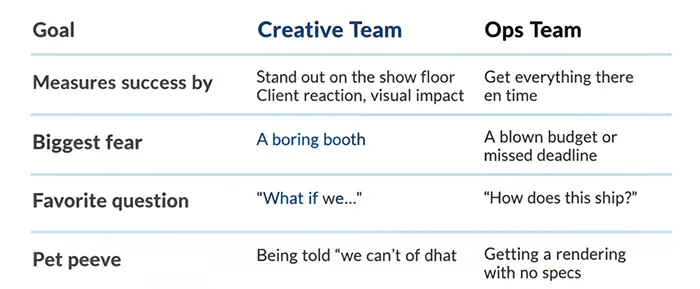
See the pattern? Both sides want the project to win. They just define "winning" differently.
"Ops doesn't want to kill your idea. They want to keep your idea from killing the budget."
Where It All Falls Apart
The worst projects follow the same pattern. Every. Single. Time.
- Creative finishes the concept in isolation
- The rendering gets client approval
- Someone emails it to Ops with the subject line: "Here you go, make it happen."
- Ops reverse-engineers the entire build
- Costs climb. Timelines shrink. Stress goes through the roof.
Sound familiar?
This is what the industry calls "throwing it over the wall." And it's responsible for more budget overruns, overtime charges, and show-floor panic than almost anything else.
The real cost of a bad handoff
When Ops gets pulled in late, here's what typically goes sideways:
- Overtime labor charges: I&D labor rates vary by city, and overtime can run 1.5x to 2x the standard rate. In union cities like Las Vegas and Chicago, those costs add up fast.
- Rush freight: Last-minute shipping changes can double or triple your logistics costs.
- Onsite change orders: That element Creative designed without checking venue rules? Now it needs to be rebuilt on the show floor. With union labor. On overtime.
- Material waste: Components that were fabricated to spec but don't fit the venue's actual dimensions.
One bad handoff on a 30x30 island booth can easily add $10,000 to $25,000 in unplanned costs. That's not a rounding error. That's someone's profit margin.
Where It Actually Works
The best projects we see start differently. Creative and Ops sit at the same table from day one. Not day 30. Not after the client signs off. Day one.
Here's what that looks like:
Creative says: "We want a dramatic overhead element that stops traffic."
Ops says: "The venue has rigging points at these locations. Here's the weight limit. Here are two ways we could build it."
Creative says, "What if we did option B but added integrated lighting?"
Ops says, "That works. We can pre-wire it in the shop, so the install takes 45 minutes instead of three hours."
Now the idea gets sharper, not smaller. The 18-foot logo might stay. Or it might become something smarter that still wins the room but ships in half the crates.
"The best creative work doesn't happen when Ops says yes to everything. It happens when Ops says, 'Here's how.'"
The Five Questions Ops Wishes Creative Would Ask First
Before your next concept review, try running the design through these five filters:
- "How does this ship?" - Will it fit in a standard crate? How many trucks does it need? What's the freight weight?
- "What are the venue rules?" - Height restrictions, rigging limits, fire codes, union requirements. Every convention center is different.
- "How long does this take to install?" - If the answer is "longer than our move-in window," you have a problem.
- "What happens if something breaks?" - Can it be fixed onsite, or does the whole element fail?
- "Who's touching this onsite?" - Your own crew? Union labor? A mix? That changes the install plan completely.
These aren't creativity killers. They're creativity protectors. Answering them early means fewer surprises later.
A Tale of Two Booths
Let's compare two real-world scenarios that play out at trade shows every single week.
Booth A: The Wall Toss
- Creative finishes rendering three weeks before the show
- Ops gets the file with minimal specs
- Fabrication is rushed. Two components don't fit.
- Freight arrives late because nobody confirmed dock times
- Install crew works overtime to fix problems onsite
- Client walks the booth and notices a graphic is crooked
- Everyone is stressed. Nobody is happy. The agency eats $12,000 in overages.
Booth B: The Early Huddle
- Creative and Ops kick off together six weeks out
- Ops flags a rigging issue in the first meeting. Creative adjusts the design.
- Fabrication has clear specs and enough lead time
- Freight is booked with confirmed dock windows
- The install crew follows a detailed plan. No surprises.
- Client walks the booth and says, "This is exactly what I pictured."
- The agency protects its margin. The PM sleeps that night.
Same agency. Same talent. Same budget. Totally different outcome.
What We See From the Ops Side Every Day
At CREW XP, we live on the operations side of this equation. We're the ones on the ground in Las Vegas and Orlando, handling fabrication, logistics, I&D labor, and project management for agencies and exhibit houses.
We've seen both versions of this story hundreds of times. And we can tell you exactly when a project is headed for trouble.
The warning signs:
- The rendering arrives with no dimensions
- Nobody has checked the venue's exhibitor kit
- The install timeline assumes everything goes perfectly
- There's no backup plan for the custom element
- Ops was cc'd on the email, not included in the meeting
The green flags:
- Creative and Ops reviewed the concept together
- Someone already pulled the venue's rigging specs
- The install plan has buffer time built in
- Components were designed to be modular (easier to ship, easier to fix)
- The fabrication partner was looped in early
We have over 250 years of combined industry experience on our team. We know the convention centers. We know the dock schedules. We know which venues have tricky union rules and which ones give you more flexibility.
That knowledge is worth a lot more when we get the call six weeks out instead of six days out.
The Creative-Ops Alignment Checklist
Want to stop the war before it starts? Use this checklist on your next project:
- Kick off together. Creative and Ops in the same room (or Zoom) from the start.
- Share the venue specs early. Ceiling heights, rigging points, electrical locations, and dock access.
- Set the budget guardrails before design begins. Not after.
- Build in a "buildability review" before the client sees the final rendering.
- Confirm freight and logistics timelines alongside the creative timeline.
- Identify the "hero element" and pressure-test it for install feasibility.
- Create a shared project timeline that includes design milestones AND production milestones.
- Loop in your fabrication and I&D partner early. (That's where we come in.)
Why This Fight Will Never Fully End (And Why That's OK)
Here's the truth. Creative and Ops will always see the world differently. That's not a bug. It's a feature.
You want your creative team pushing boundaries. You want your ops team asking hard questions. The tension between "what if" and "how do we" is where the best work lives.
The goal isn't to eliminate the tension. It's to make sure it happens at the right time, in the right room, with the right information on the table.
"The best exhibits don't come from creative alone or ops alone. They come from the argument that happens when both sides care enough to push back."
So, Which Agency Are You?
Be honest. Which one sounds more like your last project?
Agency A: Creative throws a rendering over the wall. Ops scrambles. Everyone survives, barely. The client never knows how close it came to falling apart.
Agency B: Creative and Ops build the plan together. The install is calm. The client thinks your agency is magic. You actually make money on the project.
If you're closer to Agency A, you're not alone. Most agencies start there. The ones that grow into Agency B do it by changing one thing: when the conversation starts.
Not what gets designed. When the people who build it get involved.
Ready to Build It Right
At CREW XP, we make the Ops side easier. We handle custom fabrication, logistics, I&D labor, graphics, and project management in Las Vegas and Orlando so your team can focus on the creative work that wins clients.
We know the venues. We know the dock times. We know the rules. And we'd rather get your call early than get your panic text the night before install.
Get in touch:
- Email: projects@crewxp.com
- Phone: 407-852-1910
Your creative team has the vision. Let us help you actually build it.
Got questions for our team? Give us a call or fill out the form below and our team will be in touch as soon as possible.